

There is a question every training provider eventually asks when evaluating apprenticeship management software: does it matter how the platform was built, or only what it does?
It matters. It matters more than most vendors will tell you.
The difference between a platform and a bundle
A platform is designed as a single thing. Its data model, its user experience, its workflow logic, and its reporting layer were conceived together, tested together, and have been running together for years. When a learner’s progress updates in one part of the system, every other part knows immediately. There is no translation layer, no synchronisation job, no “these modules are currently integrating” message in the product roadmap.
A bundle is a different proposition. It is a collection of products, each originally built by a different company, for a different customer base, on a different technology stack, now sold as if they were one thing. The integration between them is real work, ongoing work, and work that is always trailing the promise made at the point of sale.
Both can be described as “end-to-end apprenticeship management”. They are not the same thing.
What Aptem Apprentice actually is
Aptem Apprentice is a purpose-built apprenticeship delivery platform. It was designed from the start to handle the full delivery lifecycle: enrolment, off-the-job tracking, ePortfolio evidence, functional skills progression, ILR and funding compliance, reviews, end-point assessment preparation, and achievement. Every part of that workflow was built by the same team, for the same customers, in the same product.
Aptem has been building this way for over a decade. The platform now supports nearly 200 training providers, with more than 130,000 learners and jobseekers using it daily. That number is not a marketing extrapolation across multiple business lines. It is the count of people using Aptem for apprenticeships, employability, and skills training specifically.
The achievement data reflects the quality of the underlying product. Aptem customers achieve a 15.4% boost in learner achievement rates, 7.2% average annual provider growth (source: DfE apprenticeship data), and up to £200,000 saved each year. This was recognised by the judges at the Learning Technologies Awards 2025, where Aptem won Organisation of the Year.
Why the origin story of a platform matters to buyers
When a training provider signs a multi-year contract with a software vendor, they are not just buying the features listed in the demo. They are buying the roadmap, the support model, the data continuity, and the integration stability over the contract term.
A platform assembled through acquisition carries risks that a purpose-built platform does not.
Products that were not built together must be integrated. That work takes years, not months. The joins that are promised on a slide deck in a sales meeting are frequently still being engineered 12 to 18 months into a contract. Providers absorb the cost of that instability: support overhead, workarounds, data inconsistencies, and roadmap items that block each other.
When a vendor owns multiple products that are being converged, the engineering capacity is split. Features that would improve delivery on one product are delayed because integration work comes first. Customers of a bundle-in-progress are funding the integration as much as they are funding product improvements.
Products assembled by acquisition are often owned by financial investors with a defined exit horizon. That is not a moral judgement; it is a structural fact with practical implications. Who owns the vendor in three years? What happens to the roadmap in a sale? What happens to the support team? A provider signing a five-year contract deserves a clear answer to those questions.
None of these risks are hypothetical. They are the documented pattern of software consolidation in every sector, including education technology.
The AI question
Every platform in this market is now making AI claims. The right question is not “do you have AI?” but “where does the AI sit, and how is it governed?”
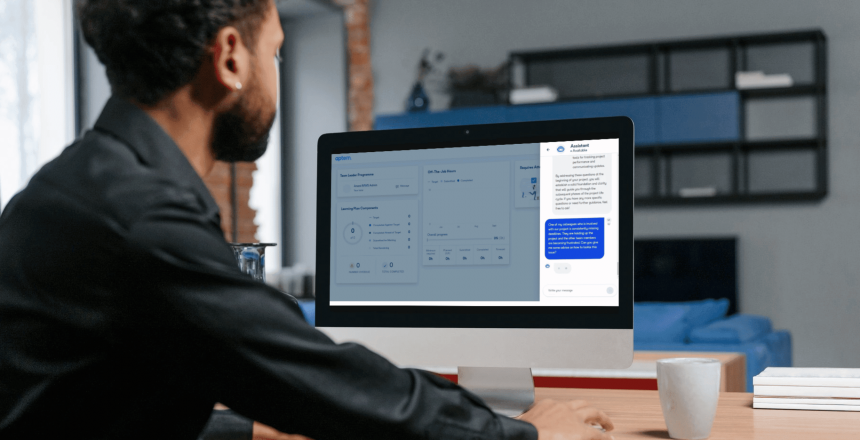
Aptem Enhance is not a feature bolted onto an existing product. It is a set of AI capabilities embedded in Aptem Apprentice’s core workflows: ability to auto summarise reviews saving 10 days of admin time per customer every month, a built in feedback assistance, marking support, and 20,500 virtual assistant messages (65% growth year on year), saving customers the equivalent of every working day of the year by replacing 5 minute phone calls and answering routine queries.
These are not demo features. They are in production, used daily, by real tutors and assessors at real providers. Read this case study with Hawk Training to see the genuine impact Aptem’s AI features are having on a leading training provider.
An AI feature built into a product assembled from multiple acquired codebases is working against the grain of the architecture. The data it needs to be genuinely useful — learner history, OTJ records, evidence quality over time, compliance signals — is distributed across products that are still being integrated. AI that cannot see the full picture cannot give a full answer.
What end-to-end actually means
“End-to-end” is one of the most overused phrases in apprenticeship software. It is worth being precise about what it requires.
True end-to-end apprenticeship management means a single system handling:
- Enrolment and employer onboarding
- Individual learning plan creation and management
- Off-the-job hours tracking, with evidence
- ePortfolio: knowledge, skills, behaviours, gateway evidence
- Functional skills progression and assessment readiness
- ILR data quality and DWP funding compliance
- Reviews with AI-assisted note-taking, summarisation and action planning (progress reviews, tripartite reviews, eligibility reviews and more)
- End-point assessment preparation
- Learner achievement and outcome recording
It also means that the data flows between these stages without manual intervention, without a synchronisation job, and without a support ticket when the handoff breaks.
Aptem Apprentice does this. Not as a bundle. As one product.
“Before Aptem, data from different platforms rarely matched, admin was overwhelming, and we risked losing sight of what mattered most – helping learners and employers succeed.” Ektaa Mahay, Director of Audit and Compliance, tend
The sector focus point
Aptem builds software for apprenticeships, employability, and skills training. That is the whole business. There is no healthcare division, no legal software line, no HR platform. Every engineer, every product decision, every customer success resource is aligned to the same problem: helping training providers deliver better outcomes for learners.
That focus has a practical consequence. When a training provider calls Aptem with a problem, the person answering has never had to say “I cover your module but not theirs.” There is no “theirs”. There is one product, one team, and one answer. Our customers describe it better than we can:
“There is an excellent support and development team behind the tool who are a real pleasure to work with.” Richard Bridge, Director of Learning Technology, Corndel.
“The Aptem support team has been an invaluable partner in helping us achieve our goals. We have contacted them with a wide range of needs. The quality of support has been consistently excellent. We are continually impressed by how quickly the team responds, how clearly they explain solutions, and the consistency of their ongoing support.” Craig Watling, Support Team Leader, Lifetime.
“The Aptem team was so supportive during the R14 period. I don’t know what I would have done without their help and guidance. They were readily available at the end of the phone for any last minute queries, displaying a genuine partnership approach.” Stephanie Smith, Apprenticeship Manager, National Film and Television School.
The evidence base
Aptem holds ISO 9001 and ISO 27001 certification, and Cyber Essentials Plus accreditation. The platform is listed on the UK Government Digital Marketplace (G-Cloud).
Customers who use Aptem publicly include Corndel, Lifetime, Nottingham Trent University, London South Bank University, Barnsley College, Bradford College, Tyne Coast College, BMS Progress, Hawk Training, and Pareto.
229 new features and enhancements were shipped in 2025. The product is not standing still.
What to ask any vendor
If you are evaluating apprenticeship management software, these questions cut through the positioning quickly.
- Were all parts of this platform originally built by the same company, or assembled through acquisition? If assembled, what is the current state of the integration?
- Where does your AI sit in the architecture, and which parts of the learner record does it have access to?
- What is your ownership structure, and what is the planned exit horizon for current investors?
- Can you show me the data flow between ePortfolio, ILR submission, and OTJ tracking in a live environment?
- What does your roadmap look like for the next 12 months, and what proportion of it is integration work versus net new capability?
The answers will tell you more than any slide deck.
Aptem Apprentice is used by the largest training providers across the UK. If you want to see what a purpose-built apprenticeship platform looks like in practice, book a demo.
